25 May 2010

Pomegranate

 Pomegranate
Punica Granatum
Native to Asia from the Mediterranean to the Himalayas
Cultivated for its desirable fruit which is loved throughout Asia and the Mediterranean

A Garden of Pomegranates; an Outline of the Qabalah

Incredible Pomegranate: Plant and Fruit

The naturally twisting trunk appears to be gnarled and ancient


Uro: Hole in trunk with healed edges


One can sow seeds in the spring for a Misho There is no such thing as "bonsai seed". The packs of seed marked as such, are just ordinary tree seeds that can be grown into a bonsai. They are a good source of tree seeds when none are locally available.

Creating bonsai from collected seed costs less and is very rewarding

flowers well when slightly root-bound


Can be air layered once spring growth begins to harden


(Punica Granatum var. Nana)

short branches will bear more flowers.


Dwarf Pomegranate Bonsai


A sub-tropical, deciduous tree grown for its brilliant orange-red trumpet-like flowers followed in fall by ornamental, small, spherical-like orange-red fruits. Has dark green leaves. Slow to moderate grower. Deciduous: drops foliage during winter. Protect from hard freeze during winter, If one likes flowers and fruit on bonsai, the Dwarf Pomegranate is excellent! The leaves are smaller and finer. The fruit and flowers are small. The flowers form on the tips of branches. Restrict the growth of long branches but do not prune shorter branches as it will prevent flowering. After flowering cut branches and shoots to just one or two sets of leaves. 

Wiring needs to be done with care because the branches can be brittle. Roots need to have space to grow, choose a pot that is slightly deeper. The dwarf pomegranate is a shrub about 1meter tall. The slender branches start out upright then droop gracefully. Unpruned shrubs have a weeping or fountain shaped habit. To encourage flowers and fruit, use a fertilizer that's low in nitrogen but high in both potassium and phosphorous.


dark green narrow leaves

18 May 2010

It is Satsuki Azalea Season

Rhododendron indicum
Satsuki hybrids
(sats-key)

Satsuki means "fifth moon" of the lunar calendar, and bloom in May and early June. To some these varieties extend  the Azalea flower season to others they unacceptably bloom "out of season".

The Azalea species need the soil to be moist and the air to be humid.
Azaleas are flamboyant flowering shrubs, producing masses of bright flowers
Blooms lasts longer in cool climates.


Shohin Satsuki Azalea "Goko"


From Robert Mahler's workshop
Joy of Bonsai 2009
Kawa Bonsai Society


This Satsuki Azalea is laden with
pink blooms.


The Azalea species need the soil to be moist and the air to be humid.
Please remember that although these plants can be brought indoors for show at flowering time, they grow out of doors


The National Bonsai & Penjing Museum

12 May 2010

11 May 2010

The Miniature Rose as a Bonsai

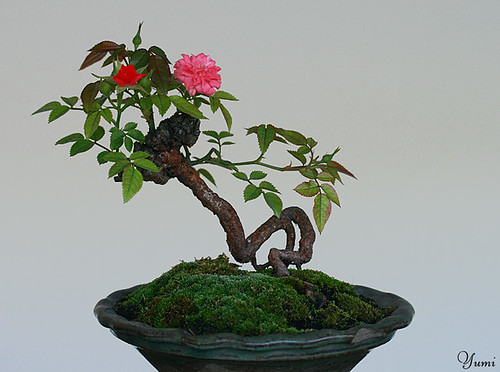
When in bloom, miniature roses are very beautiful.
rose bonsai, originally uploaded by * Yumi *.

................................................................................

The Miniature Rose Bonsai Lovers' Club was founded in July 2007.

Miniature rose bonsai is an art which values natural shape.


rose bonsai #2
Originally uploaded by * Yumi *


................................................................................

How to Make Your Own Bonsai #2
a video program featuring Minature Roses
By Kaori Yamada
fifth generation bonsai master
of Seikouen Bonsai Garden.

Saika Bonsai (colorful flower bonsai)
a modern bonsai style that
 features a combination of trees and plants
with free-spirited pot designs.
Very interesting 'bonsai' ideas that
dare to break some traditional rules


Interviews with Kaori Yamada

A Touch of Bonsai

The Attraction of Bonsai

08 May 2010

Eastern Red Cedar

Eastern Red Cedar
Juniperus virginiana


joo-NIP-er-us
ver-jin-ee-AY-nuh
In its native range, it is commonly called "cedar", however it is a juniper, not a true cedar. The wood is usually referred to as Aromatic Red Cedar. "Cedar Chests" are used to store clothing, as the wood repells moths. The Red Cedar has been used for years in Georgia as the Christmas tree. The Red Cedar grows naturally into a Christmas tree shape and is found in forests throughout Georgia.


Coastal Red Cedar

Southern Red Cedar
Juniperus virginiana
var. silicicola
sill-liss-sih-KOLE-uh
Often treated as its own species


The coastal or southern red cedar are found on the exposed sand dunes, in the dry maritime live oak and pine forests, in wetland sites on the barrier islands and along the sounds and tidal creeks. Often they are naturally sculpted into twisted, horizontal, bonsai-like configurations by winds and salt spray.

More Juniper Pictures

large Southern Red Cedar - St. Simons Island, GA

LinkWithin

Related Posts with Thumbnails