30 September 2011

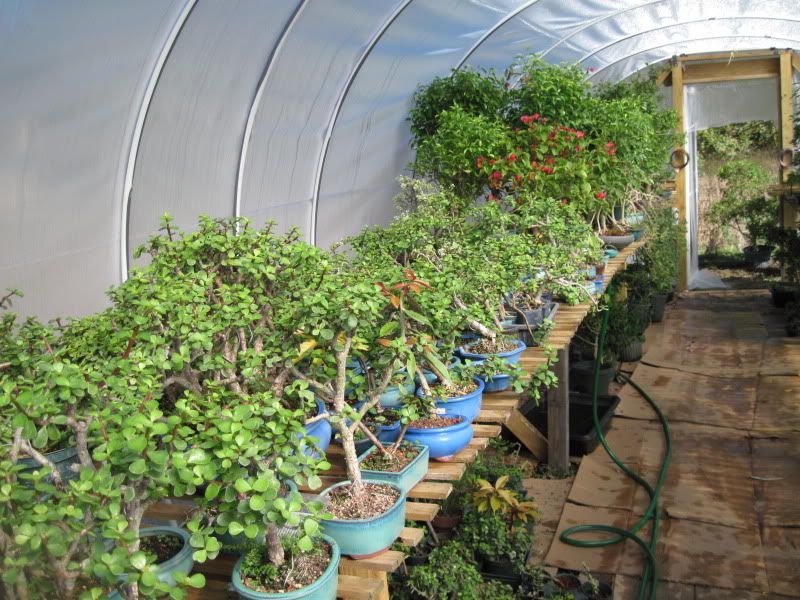
Portulacaria afra - Dwarf Jade

Portulacaria afra -
Dwarf Jade or the Elephant's Food

Easy care succulent from South Africa.
A houseplant, anywhere with adequate bright light. Drought tolerant. Chronic over watering can kill the tree. Can go for several years without repotting. But do let the soil dry out. When in doubt- don't. Avoid watering Dwarf jade late in the day or at night. Care should be taken during the winter rest not to over water (water only enough to keep the leaves from shriveling). Fertilize at one-third strength during the growing season. Prune by pinching or cutting above a pair of leaf pads.


Dwarf Jade

`Portulacaria afra,
the Elephant's Food,
Spekboom,
Dwarf Jade,
Elephant Bush
Baby Jade


Forest

Portulacaria afra Information Overload
A monograph by the Phoenix Bonsai Society


2012 re-potted  
Repot a Baby Jade bonsai every few years in the late spring when the daily low temps are above 50º F and high temps are above 90º F. Use a very well draining soil. Before re-potting, dry the soil out thoroughly. After re-potting, keep a Baby Jade's soil dry for a few days then resume to water as needed.


Unlike other types of Bonsai, Baby Jade can go for long periods without water. It stores water in the trunk, branches and leaves. Water until the soil is moist and let the soil dry between watering. Don’t allow standing water to puddle in the pot. It is quite tolerant to under watering and is a good beginner plant for home or office.


Do not use a concave crotch cutter to remove a branch, leave a nub and let it fall away naturally. After any cuts, do not water until the wounds heal. At the base of each leaf is a bud that will become a new branch. 

25 September 2011

World's Greatest Plant Swap: 1 October 2011

Fishman: A simple thank you savannahnow.com


World's Greatest Plant Swap 
1 October 2011


When: 8-11 a.m. Oct. 1
Where: 501 W.Boundary Street, In the garden between between Chatham Steel and SCAD’s Boundary Hall.
Rules: There are none. Anyone can attend. There is no money exchanged. Bring plants you want to give away and get ready to go home with plants you’ve always wanted.
Information: Call 912-484-3045 or email Jane Fishman at gofish5@earthlink.net.

Free


22 September 2011

2011 Fall Festival at the Bamboo Farm & Coastal Gardens

October 22, 2011 

The 17th Annual Fall Fall Festival
at the
2 Canebrake Road
Savannah, GA
From Hwy 204 take the Hwy US 17 S 
(toward Richmond Hill)


A family-friendly outdoor activity this fall- the Bamboo Farm and Coastal Gardens’ Fall Festival


Buddha Belly Bamboo Bonsai
  • arts & crafts vendors
  • Bamboo, plant & Bonsai vendors
  • educational lectures
  • children's activities


Fun, Food and entertainment for the entire family


Fall Festival 2010


Carve your
pumpkin


Pumpkin Patch 
Mon-Fri from 9 AM - 4 PM 
Sat from 9 AM - Noon. 
The patch will be closed on Sundays.


Be a Friend of the Coastal Gardens


20 September 2011

time to prepare the winter quarters


When will the 2011 Ice Age begin?

We are having the first cool mornings in Savannah forewarning of the soon-to-come autumn. With that snap in the air, it’s time to prepare the winter quarters of the cold sensitive trees............... 


  • Each winter, on average, our risk of frost is from November 24 through March 1.
  • Almost certainly, however, we will receive frost from December 14 through February 10.
  • We are almost guaranteed that we will not get frost from March 20 through November 4.
  • Our frost-free growing season is around 268 days.


November 21-30


light, moderate, or hard?
  • Light freeze: 29°F to 32°F—tender plants killed, with little destructive effect on other vegetation.
  • Moderate freeze: 25°F to 28°F—widely destructive effect on most vegetation, with heavy damage to fruit blossoms and tender and semi-hardy plants.
  • Severe freeze: 24°F and colder—damage to most plants.


New Benches 


Ficus Burtt davyi "nana"


The level of available potassium in the soil will increase a tree’s frost resistance.


Baby, It's Cold Outside: Blame It on the Blizzard\Deep Freeze\Melting Point     Deep Freeze      When Hell Freezes Over: A Novel  

17 September 2011

Pumpkin Patch @ the Bamboo Farm


Pumpkin Patch
at the
2 Canebrake Road

Savannah, GA 
October 8 from 9 AM - 4 PM 


Normal operating hours will be 
Mon-Fri from 9 AM - 4 PM 
Sat from 9 AM - Noon. 
The patch will be closed on Sundays.


Spring Strawberry Fields 


07 September 2011

Praying/ Preying Mantis


Chinese Mantid found in my garden 
a beneficial insect with a frighting appearance


prays then preys


Praying Mantis
as though in an
attitude of prayer


Praying Mantis or Preying Mantis


Praying mantis egg cases are purchased by farmers and gardeners to hatch an army of ferocious predators  to control insects such as mites, gnats, flies, white flies, and aphids.


"preying mantis"
they are 
"carnivorous" 
eating other insects


One generation develops each season. In the autumn, females lay eggs in a large cluster, in a frothy substance glued to tree twigs, plant stems and other objects. Overwintering occurs in the egg stage in this case. The nymphs emerge from the egg case in the spring or early summer. 


Surprise on the Morning Glory

Females regularly lay hundreds of eggs in a small case, and When nymphs hatch they are tiny versions of their parents. Leave any praying mantis egg cases hanging out on branches. There are 40-100 baby praying mantis in them.


their spiny-like forelegs can 
be readily felt as a "sharp pinch"
but they are harmless to people


03 September 2011

Ehretia buxifolia- Poor Man’s Tea


  • Fujian Tea 
  • Fukien Tea 
  • Philippine Tea 
  • Philippine False Tea
  • Poor Man’s Tea 
  • Tsaang gubat 
  • Wild Tea

Once known as Carmona microphylla,
renamed Ehretia buxifolia or Ehretia microphylla


teens love to give
their Moms a
"Fuken" Tea Bonsai


A Fukien Tea Tree Penjiing is a popular as an "indoor bonsai" plant. The Fujian Tea may not be the best choice if you are a beginner, but an experienced bonsai enthusiast will enjoy the challenge. Fukien Tea "bonsai" imports from China have become very popular commercial "Bonsai".

The Fukien Tea is a tropical evergreen tree that is common in the Fujian Province in China. It is found growing throughout eastern and south-eastern Asia and is used as an herbal tea and medicine.  Fukien tea will make you “feel young and slim”.


Flowers and foliage of a
Fukien Tea Tree
''Carmona'' bonsai


The tree produces shiny dark green leaves and miniature white flowers in the summer which eventually turn to small tomato shaped green changing to orange then to red berries. 


tomato shaped green changing
to orange then to red berries.


Keep Ehretia microphylla outdoors as long as possible and bring them in when the nighttime lows are below 50º F. Good air circulation is vital indoors. Indoors select a well lit area and warm spot. The more sunlight the tree receives the smaller the leaves will grow and if the tree does not receive the proper amount of sunlight, it will not produce flowers or berries. The Fujian Tea is relatively pest free in an open outdoor location. Indoors check regularly for pests. These trees are susceptible to scale, aphids and mealy bugs. Indoors there are no natural predators, like lady bugs to keep pests under control, so it will be up to you to deal with the pests yourself. Fukien Tea is sensitive to pesticides. Fukien tea prefers a humid environment. To create a more humid environment, place a tray filled with very small stones or gravel and fill with water and place the pot on top of the stones making sure that the water does not wick into the soil.


Ehretia is relatively pest free
 in an open outdoor location.
Train the Fujian Tea using “clip-and-grow” methods, trim frequently and use little wire. New shoots emerge from the base of leaf stalks after pruning. The most popular styles are broom, literati and cascade. There is a “Small leaf” variety is slow to develop a trunk, but bears tiny red fruit prolifically and a “medium leaf” variety develops a bulky trunk more quickly.

Keep moist but do not to overwater. Use a good well draining soil. Fukien Tea likes to be evenly moist, not soaking wet. It prefers some organic matter in the soil mix. Root bound Ehretia can deteriorate quickly. Root prune and repot in early summer when the nighttime lows are above 50º F and daytime highs are above 90º F.


Seedling under
 the mother tree.


The Fujian Tea is easy to start from seed. Remove the moist coating from the fruit, and plant immediately into moist well draining soil. Within a short time small seedlings will emerge. Sometimes seedlings sprout under the mother plant. Seedlings are excellent for Penjing or forest plantings. Start shaping them when the trunk becomes woody.


Flowers and foliage 
Fukien Tea Tree
Ehretia buxifolia


Cuttings and air layers are also good methods to propagate Ehretia.


Ehretia buxifolia is used in the Philippines and India as an herbal medicine.


Sometimes seedlings sprout
under the 
Fukien Tea Tree.


LinkWithin

Related Posts with Thumbnails